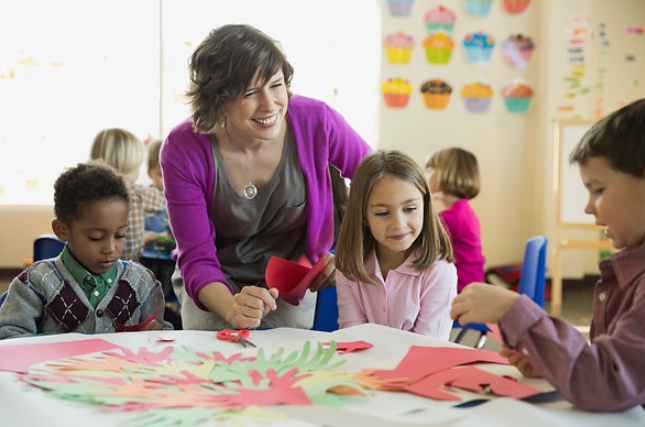
Does this sound familiar? You have got twelve children on the mat, two already rolling sideways, and the plan you made five minutes ago is not landing. That is the honest starting point for most circle time activities. The right activity at the right moment changes everything.
Here is what you get in this article. Activities grouped by what you need in the moment: attention, movement, feelings, or calm. Every one is ready to use tomorrow and easy to adapt for your own group. And when the ideas run dry, tools like Elina can spin up fresh themed activities in seconds.
Activities That Win Attention In The First Minute
The first sixty seconds set the tone for the whole circle. Get that right and you have gotten the attention of your group. These openers work because they give children something to do with their bodies and voices straight away. There is no waiting or settling in slowly. They are in it before they know it.
- A call and response chant that changes daily. "If you can hear me, touch your nose." Simple, quick, and it pulls in the stragglers.
- A mystery bag or hidden object. Curiosity does the work of attention for you.
- A name song with a turn for every child. Everyone gets seen in the first two minutes.
Quick tip: rotate three openers across the week. The routine stays familiar, but it never goes stale.
These are the kind of classroom activity ideas that earn their place because they solve a real problem: getting a room full of young children to be present together, not just physically, but in attention too.
Movement And Transition Activities For Preschool
We know that young children are not built to sit still. Movement is not a break from learning, but it is how they regulate. Good transition activities preschool teachers rely on have the magic of turning a regular hand-off into part of the fun.
Burn energy
- Freeze dance
- Animal walks
- Simple yoga shapes
- A "shake it out" countdown
Move the group
- A marching song to the next station
- "Tiptoe like a mouse" to line up
- A clap pattern that signals tidy up time
A Simple Cue System That Makes Transitions Automatic
Pick one consistent signal and use it every time you need the group to shift. Not a new one for each transition, the same one, always. It can be a bell, a chime or the same song every time. Within a couple of weeks, the cue does the work for you: the children start the move before you can even finish the sentence. Transitions stop being a daily battle and start being something the children just do.
Social Emotional Learning Circle Time Activities
Circle time is one of the few moments in the day when the whole group is together and calm enough to practice feelings and friendship. Social emotional learning activities here build the skills that make every other part of the day smoother. A child who can name a feeling has an easier morning than one who cannot.
- Feelings check in. Faces or a feelings chart, child points and names how they feel.
- "Pass the smile" or a kindness round. Each child shares one kind thing.
- A breathing buddy activity. Links the feeling to the body, which is where young children actually experience it.
- A "we made it" moment. The group celebrates something they did together.
Quick tip: keep your own face and voice steady when a child names a big feeling. You are modelling the regulation you want them to learn, whether you mean to or not.
Calm Down And End Of Circle Activities
How you end circle time matters as much as how you start it. A scrambled ending follows you into whatever comes next. These circle time ideas for preschool give children a soft landing and a clear signal that this part is finishing.
- A slow goodbye song that gets quieter each verse
- "Melting" from standing, to sitting, to lying still over a slow count
- A gratitude or "one good thing" round to close
- A quiet visualisation, "we are floating like a feather," before moving on
Quick tip: dim the energy in your own voice first. The group follows the adult before it follows the instruction.
When You Run Out Of Fresh Ideas
Even a strong teacher runs dry after the twentieth Monday of the same songs. That is not a failure, it is just what happens over a full year.
When I run out of fresh ideas, I ask Elina for themed circle time activities around whatever we are exploring that week. It gives me a starting point in seconds, and Elina adapts it for my own group immediately. It is not a replacement for what I know about my children. It is just a faster way to get to the good idea.
Try One Tomorrow
The simple idea behind all of this: match the activity to the moment. Attention, movement, feelings, or calm. That is the whole system.
You can experiment and adapt. What works for one group will flop for another, and that is completely normal. You do not need to overhaul your circle time, small changes make a real difference. Pick one new activity and try it this week. And when you want a fresh set built around your next theme, Elina can generate circle time ideas you can use straight away.
Want fresh circle time ideas in seconds?
Try Elina now!Circle Time Questions Teachers Ask
How long should circle time be for preschoolers?
Roughly five to ten minutes for younger children, up to fifteen for older preschoolers. Adjust it to the group on the day.
What do I do when children will not sit still during circle time?
Switch to a movement or transition activity, shorten the circle, and check whether the activity actually matches their energy that day.
What are good circle time activities for a large group?
Call and response chants, group movement songs, and whole group feelings check ins. All of these give every child a quick turn without slowing things down.
How do I keep circle time fresh every day?
Rotate a small set of openers and closers, change the theme weekly, and use a tool like Elina when you need new ideas fast.
What is the best way to calm children at the end of circle time?
Lower your own voice and pace first. Then use a slow goodbye song or a short breathing activity to bring the group down with you.
For more on building routines that hold up in real classrooms, sign up to Elina for research backed guidance on developmentally appropriate practice.